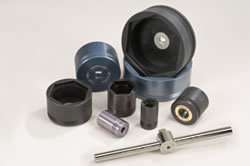
BETA® Backshell Accessory Tools
ADAPTOR TOOLS
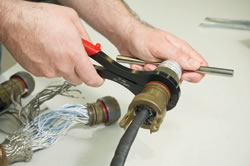
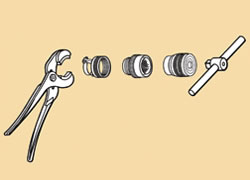
ADAPTOR TOOL COMPATIBILITY WITH OTHER BETA PRODUCTSAdaptor tools and other accessory tools which comprise the DMC BETA® product line are used in a variety of combinations to afford the user an efficient and flexible system of connector/accessory assembly. The following illustrations depict a few of the products which are combined in use. Certainly there are many applications which are not described. The selection of tools and the ways in which they are used are both dependent upon the types of connectors and accessory components as well as production and quality considerations. DMC will help with any application questions you may have. SIMPLE HAND TIGHTENINGIn the most basic operation, the adaptor is mated with the connector, and held in one hand. this stabilizes the connector while the backshell accessory is tightened with the other hand.
SIMPLE MECHANICAL ASSISTWhen mechanical assistance is necessary to sufficiently tighten the accessory onto the connector, the stabilizing effect of the adaptor can be reinforced with one of several tools — in the operation shown, the connector is held stationary by the use of a “T” handle in the drive hole of the adaptor, while soft jaw pliers are being used on the accessory. NOTE: Rotating the connector is not recommended — due to the stress which it imposes on the wire, contacts and sealing components. Adaptors and their associated tools that are designed to hold the connector stationary while the backshell accessory is turned
PRODUCTION STATION APPLICATIONSWhen the measurement of torque is a requirement of a particular cable assembly operation, this can be easily accomplished with the use of the static torque meter. The adaptor is attached to the square drive on the torque meter, and this arrangement holds the connector while the backshell accessory is torqued onto the connector, with a strap wrench. When the torque reaches the value set on the dial, a signal light advises the operator that the desired torque value has been applied.
When optimum repeatability and production efficiency demand, the assembly station vise can be used to complement the ability of adaptor tools to stabilize the connector. As shown, the vise is being used to firmly hold the adaptor tool, while a strap wrench is being used to tighten the backshell onto the connector.
On multi-piece backshell, the correct torque on each accessory ca only be achieved by efficiently holding adjacent parts. In the example shown, the assembly station vise is being used to hold the backshell segment already torqued onto the connector, while the strain relief is tightened with a strap wrench and a torque meter. Thus, the correct torque can be applied to the backshell segments without affecting the torque value already applied to prior connector/accessory components.
CONNECTOR MATE® ASSEMBLY VISE
STRAP WRENCHES
|
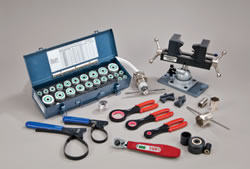 The evolution of circular connectors has produced a multitude of configurations which have more precise dimensional tolerances and electrical characteristics than any other mechanical component used in modern electrical systems. The associated tooling must meet the same level of precision to apply the connector to its intended purpose. Until now, very little attention has been focused on the tooling which is used to mount strain-relief backshells and other accessories to wired connector assemblies. This is why the BETA® system was developed.
 This unique concept is based upon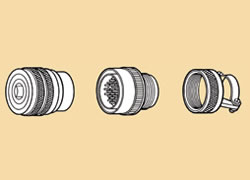


 The
The